
An expat in Vancouver first impressions: Food II

Ethnic food is as appealing to me as the next person (aka a lot), but ethnic desserts probably more.  Yes, very, very occasionally I’ll fall for a piece of a cloying Red Velvet Cake, but mostly I’m interested in ethnic desserts as part of a metaphorical anthropological dig, as if identifying edible cultural artifacts as a expression of humankind’s adaptation to the particular conditions of geography and history.  Yes, really. If I could do a fourth career in food culture, I would. I might. What’s great about living in Vancouver is that I can excavate practically on my doorstep.

The small and inexpensive ethnic eateries of Vancouver are the best places to savor the traditional taste of home for many different Asian communities.

Filipino yam pastry

Like the squash and sweet potato family? Well, then you’d be in luck, wouldn’t you? Personally, I’d take a squash dessert over chocolate mousse any day.   This delectable yam treat is on the heavy side (it was the first time I’d noted the slick taste of shortening in a pastry in ages) but the filling had that chestnut-like aftertaste of a roast sweet potato.

The Spanish colonial influence left its mark in the various sweet breads and flans that a second nearby Filipino bakery produces fresh daily. Try, just try, to hold yourself back from the open door ’round about 11am without being lured in by the fresh, warm aroma of pan de sal, flan and sweet buns prickling away at the salivary glands. Mostly these are variations on an egg, milk, butter, flour base with coconut flakes or cream thrown in.  The proportions vary, but otherwise, it’s all based on the same idea.  Sugary, rich, flecked or scented with just enough coconut to conjure up fantasies of palms swaying in the tropical breeze.

Filipino coconut cake

In Filipino and Malaysian eateries I’ve noticed variations on a black rice and coconut pudding.  Exotic! This is definitely not the most appetizing-looking dish to the untrained eye. I’ll go so far to say it is not the most appetizing dish *period* to most non-Asians.  My husband took one look at this and his lip involuntarily curled. But if I lived in Manila, this bland and mildly sweet dish is probably what I’d make to round out a meal of spicy pork stew.

Look at how wonderfully dense it is with rice and coconut milk.  There must be very little sugar in the recipe because it was about as sweet as plain oatmeal. Like most of the Filipino sweets I’ve tried, it weighed me down for a few hours.  Next time I’ll make this a meal in and of itself.
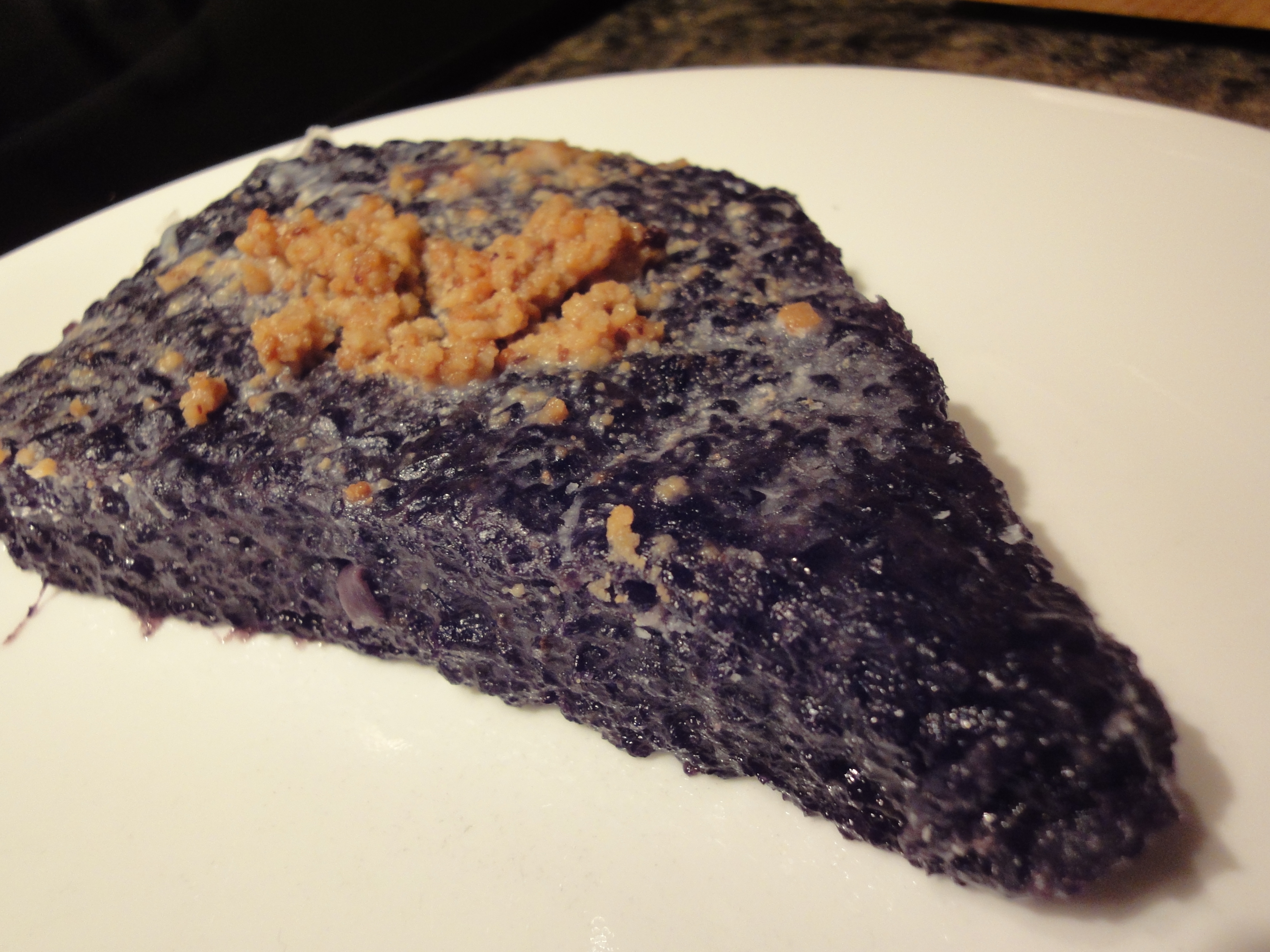
Filipino black rice and coconut pudding

I’m quite captivated by the whole new world of Filipino sweets that I’ve only begun to discover, and to which I will be devoted for many days to come.

And then there’s Indian.  North Indian, to be exact.  Apparently the choices of sweets originating from this part of Asia s are endless. The sweet shops on Main and Fraser Streets display shelf after shelf of small squares, rectangles or balls of condensed milk, sugar, mung bean, lentil, vegetable, coconut mixtures that end up melting in your mouth. My favorite: the mini-brownie sized bites of carrot halwa. At about $.50 CDN each, they are the best deal in the city.
Box of sweets from Dahliwal Sweet Shop

I’m still sorting out the names of everything; for now I’ll go by taste alone.
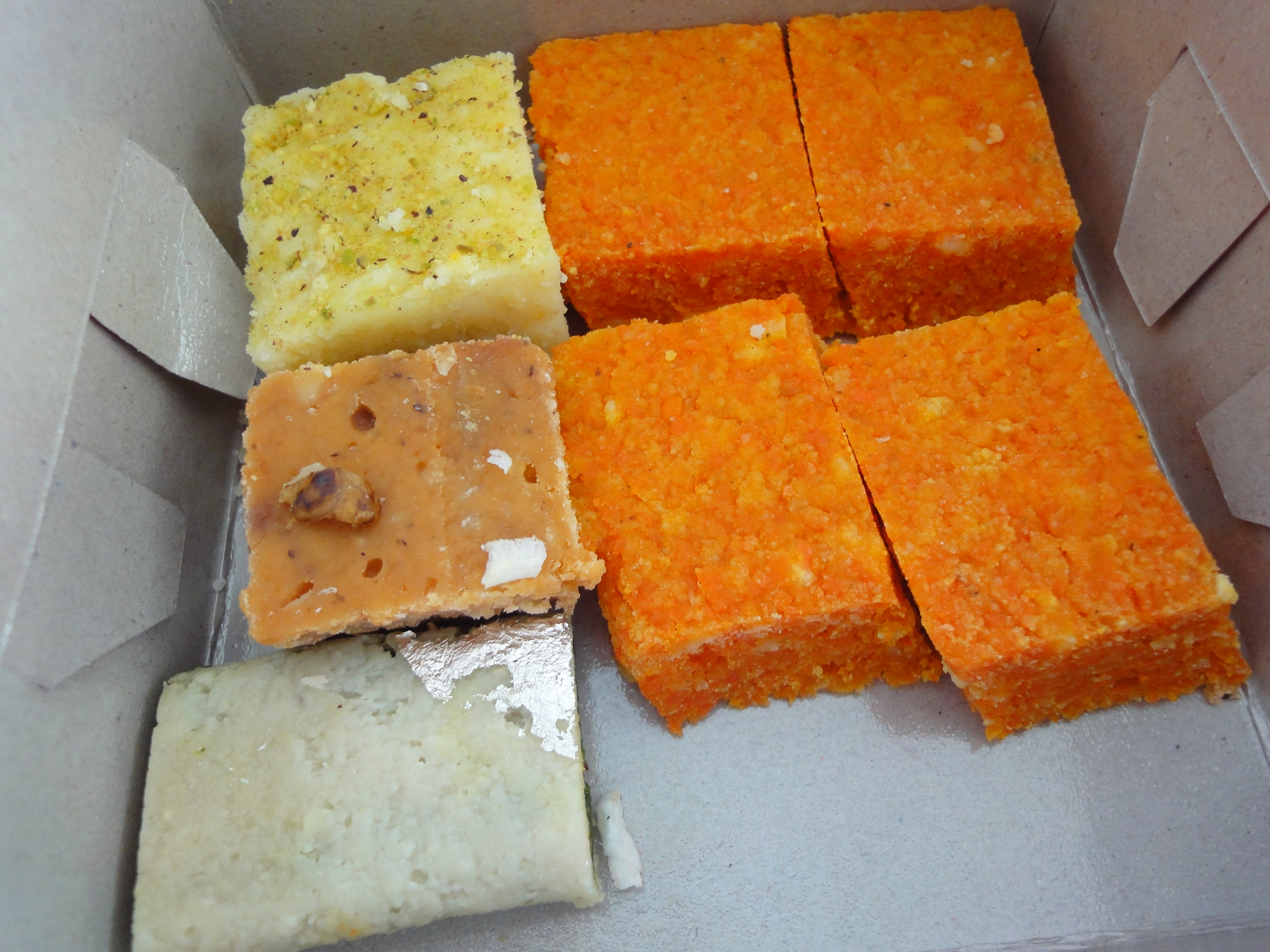
The reddish squares are the carrot halwa

Most people are well-acquainted with Thai food. But no one — absolutely no one — I know actually likes the sticky rice and coconut dessert that is ubiquitous wherever Thai food is served.  Except me. In fact, since I first tasted it in Bangkok many years ago, I’ve been on a perpetual search for the real thing, forcing me to sample far too many examples of this dish to count. Outside of Pok Pok in Portland, Oregon, I’ve yet to experience anything like that dark and damp night so many years ago, where through my jet-lagged stupor my overstimulated senses were struggling to reconcile the visual cacophany of brightly colored silks and cottons, the heady whiffs of tamarind and basil, the noisy foreign babble, and the ringing din of happily toasting and chatting fellow diners, before being rescued by the familiar yet exotic, sweet but salty, firm but tender, taste of calm delight as the first creamy rice kernels reached my lips.

Thai sticky rice with coconut and fresh mango

I’m searching still. But in the meantime, I get close enough to evoke those fond memories. And sometimes, if only for convenience, a version made with tapioca will do.

Thai tapioca and coconut

Lastly, one can’t bypass the Chinese bakeries. They are actually Cantonese, which due to the British colonial experience and some other cultural influences are nothing like Mandarin desserts. My favorite? The bun is European — sugar, egg, butter — but the filling of pudding-like consistency is red or mung bean. It’s like a custard, only made of out legumes! Talk about doing the most with what nature has given you. I hadn’t realized that the bakery with all the standard wedding cakes in the window was actually Chinese until I stepped inside to inspect the premises while I waited to meet a friend for lunch at the Indian place on the corner. Before lunch was over I had decided to have Chinese dessert.

That’s it for now. It’s Friday and the dig beckons. What’ll it be? The home made saffron and rose water ice cream by the Persian grocer?


Posted in food, Uncategorized | Tagged , , , , , , , | 2 Comments

An expat in Vancouver first impressions: Canadian politics

I have not been resident here long enough to make meaningful impressions, except to say that politicians argue, debate and fight here as much as anywhere. They don’t seem to sling mud (or worse) and make personal attacks and outright lie.  Politicians here might be called mediocre, or banal, and charisma-free, but I haven’t noticed anyone being accused of being a radical, a non-citizen, Hitler or a devil. (Stephen Colbert has a view of “Chaonada” that is making the rounds.) Corrupt, yes. Out of touch, yes. A traitor, no.

There’s an election coming up, the fourth in seven years, and the opposition parties (the liberals) seem to have finagled it

Stephen Colbert parodies the upcoming Canadian election.

in a way that does not earn them respect, but the outcome seems to be predetermined in favor of the current ruling party (the conservatives).  It should not come as a surprise to anyone that the electorate is most concerned about money: the economy, government spending and the safety net. Thankfully, the campaign season will last not much more than a month.

For an enlightening and entertaining review of Canadian politics by Michelle Dean go here. And to see which Canadian politician you are most likely to vote for go here.

Posted in expat, expat life | Tagged , , , , , , | Leave a comment

An expat in Vancouver first impressions: Medical care

This week marked an important milestone in our move to Vancouver: use of our newly minted medical benefits card.

Back in the U.S. we heard all the horror stories about Canada’s socialized medicine as broadcast far and wide in the U.S.  We heard about the shortages of medical staff and testing equipment, the rationalized lab tests, the lower standards of service that arise out of a system that is not held accountable by the threat of lawsuits as it is in the U.S.

We took it all with a grain of salt. Of course there are horror stories. There are everywhere, including in the U.S. There are studies that reveal such egregious medical malfunction that they’ve made national news. Bad service? Well in the U.S., more than once, I have waited in the office waiting room longer than 1.5 hours for my scheduled doctor’s visit. More often I’ve been under the impression that a doctor is taking a wild guess to treat what’s ailing me. Surgeries have been recommended,  which I’ve mostly ignored, and recovered anyway. If doctors bother to read the thick file containing my medical records, I remark on it as it happens so infrequently.  Then there’s the over-use of antibiotics and the tendency to prescribe dubious pharmaceuticals with terrible side effects, just to get me out of the office before my allotted 15 minutes are up.  And if one considers the high fees consumers pay because of the medical malpractice insurance burden,  it’s not a surprise that compliance with medical regimens is a challenge.

So there are gaps in the quality of service any where you look, probably even in France.

What is important to remember about Canada’s nationalized health insurance is that it has been at times oversold and at others unjustifiably denigrated in the U.S.

For example, people tend to think “universal” is synonymous with “free.”  Wrong.

Every one of the 10 provinces has a different cost structure covering medical visits, tests, surgeries, at home care, prescription drugs, medical equipment/prosthetics, ambulance etc.  In B.C., my husband and I pay about $100 each month for the both of us.  In the U.S. that would be about $1000.  Prescriptions are covered after a $2000 deductible; but prescriptions are much, much cheaper than in the U.S.  If you can afford a supplemental plan, or if your workplace provides the benefit, for about $80 a month then your prescriptions, dental, vision and alternative medical care are covered.

Besides the affordability, Canadian health insurance cannot be taken away because of a pre-existing condition.  No matter what is wrong with you, you are covered.

Indeed, I’ve read about medical staff shortages particularly in rural areas. I recall seeing similar reports in the U.S. But people warned me that it would take a long time to find a doctor taking new patients. All I can say is a doctor was recommended by a new friend and we got appointments with her right away.  Then there is the “they don’t do the necessary tests to save money” trope.  In our introductory visit, our doctor decided it had been long enough since our last physicals to have all the blood work done, so we took her referral to the lab next door, handed it in, and waited our turn.

Another benefit is the paperwork, i.e., lack of.  You pay your monthly bill and then off you go.  You do not have to open your wallet at the doctor’s office.

My point of view is that if you have appropriate expectations, you are generally satisfied. Canadians routinely poll as very satisfied with their health care, I think in part because their expectations are reasonable.  Health care is expensive. It seems like denial or wishful thinking to believe governments can provide quality health care at no cost to the consumer. However having government assume the role of ensuring there is health coverage for all, no matter how rich or poor, however reflects a civic spirit that I value deeply.  It goes to the heart of what is different between the US and Canadian societies.  It is a form of wealth distribution that helps equalize society and make it more democratic, and less individualistic.

I imagine that’s what lies at the heart of opposition in the U.S. to a national health care program. The program would probably radically alter Americans’ attitudes towards responsibility to the group,  and that Ayn Rand individualism the far right so loves might be rendered irrelevant.

Posted in expat, expat life, France, Uncategorized | Tagged , , , , , , , , , , , | Leave a comment

An expat in Vancouver first impressions: Pluses

We are entering week six, with one week in Portland to break it up, and are getting over the stunned zombie like ordeal of the move. Vito the Lagotto has his favorite spots for a good snore, and we are in the walk, work, gym, shop routine in our little urban microcosm of the Mount Pleasant neighborhood.

So I’m keeping track of what we find to be the net pluses of living in Vancouver, versus Portland, or the US or anyplace else. These are factors that go beyond the obvious, e.g. great views.

French radio and television. We love the wonderful French-Canadian pop, rock and jazz played on this station. OK, some of it is ersatz Jacques Brel or Charlotte Gainsbourg, but most of it is interesting and fun. Canada has great music bands and jazz festivals, and Montreal produces a lot of it. Listening to the station also helps scrape the barnacles off the French pathways in my brain, so soon I’ll be able to catch the band names and song titles more easily too.

Global context. I’m pretty good with languages and accents, but every day here I overhear some that I do not recognize at all. It’s a good reminder that the world is infinitely varied and mysterious. And because of Canada’s more expansive foreign policy, it’s joltingly refreshing to see uncomplicated references to Cuba, a favorite inexpensive vacation destination. (And you can buy Cuban cigars here, for those of you who pine for them.)

Public transportation! I had no idea the Canada line and Skytrain were so extensive. And we live in-between them, so combined with the great bus transport we can get anywhere without a car. Walking along the seawall we discovered several stops for the cute little Aqua Bus that crosses Burrard Inlet and makes the jaunt from the West End waterfront to North Vancouver’s Lonsdale Quay (and nearby Persian neighborhood with its markets, nut shops and bakeries and restaurants).

The city grid. We were aware that the city had rejected highways through town as part of its urban planning, but we didn’t realize what this actually meant for quality of life. It means traffic always flows. It means there are sidewalks everywhere and one can walk the entire city. It means no loud highways marring an otherwise pleasant meander. And it makes possible safe bike passage zones through neighborhoods.

Ladies Only gym rooms. I still don’t understand how this evolved, but we noted in several of the gyms we visited that they offered workout rooms for women. At our gym, this room has a large sign outside basically telling men to stay out. My theory is that the practice arises out of Canada’s diversity and tolerance, because it allows women who are culturally inclined to be extra modest to have the same chance as everyone else to work out in peace.

More later, I am sure.

Posted in expat, Uncategorized | Tagged , , , | 5 Comments

An expat in Vancouver first impressions: housing

Vancouver is famous for its condo skyscrapers but I for one had not heard of its strata home ownership laws until I started spending time in the area. In a strata property, people own their piece of the building and common areas are commonly owned.  So if your family owns a large heritage house but you can’t afford the upkeep and taxes now that it’s worth millions, you break it up into four homes and sell off three.  It is common to see large craft houses with four mailboxes, a front door, a side door, a back door and a garden or second story door.

The strata approach is appealing as a solution to keeping homes affordable and increasing density versus sprawl. Now, I say this about Vancouver which has some of the highest housing prices in North America and only rising to stratospheric levels and occupies a large geographical area. But it’s all relative, right? Imagine how much worse it could be with this innovative solution. And imagine this approach in a city like Portland, where strata could have a huge impact on the ability of young people to qualify for mortgages.  There are other benefits of strata e.g. “community pricing” that can result in savings on utility bills. For the community, the benefits include maintaining the aesthetics and health of the neighborhood, as by law the houses have to remain maintained.

I say give it a try in the Hawthorne and Belmont districts, Portland.

Posted in expat life | Tagged , , , , , , | Leave a comment