The spirit of the movies

Went to the movies today to get some laughs.  Don’t we all need some of that of late?

It was not a completely successful outing. Previews included this and this.  I happened to notice this was also on the schedule.

It is this sort of trailer that keeps me from frequenting the multi-plex more often. These trailers are obscene assaults on the senses and spirit, especially when the movie you have paid to see is in an altogether different vein. So the movie theaters don’t get the audiences for the movies they play.

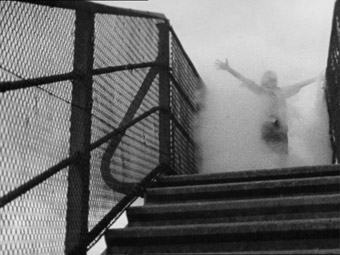
Me, I’m not in the mood for nihilism. How much more difficult is it to create a work of simplicity, subtlety and delicacy such as the classic film I watched earlier in the day. It is as spare as the life of material and emotional poverty it depicts without a trace sentimentality. Its beauty lies not even so much in the story it tells as in the way it does so. In its unadorned truth, its autobiographical depiction of a post-war childhood of deprivation is a model of artistic self-control. It is no wonder, given what’s on offer at the movie theaters, and in a political climate thick with obfuscation and subterfuge, that I would be so pleased with something as starkly and plainly observed and respectful of the audience.

Posted in culture, Uncategorized | Tagged , | Leave a comment

Waitress as VP

I discovered a diner in lower Manhattan that will now be my favorite breakfast eatery when I’m in New York. Smack in the middle of a very trendy area of cafes, bistros and food markets, not to mention boutiques, this diner is free of pretensions to anything but what appeals to mainstream New Yorkers. I wish I could have recorded the ordinary, non-ironic conversation of the two men in the booth behind mine. Posh accents they certainly did not have. Deliciously authentic to New York, they were so rich I could have listened to the strange music for hours.

My male dining companion pointed out that virtually every customer was male, while a bevy of very congenial and leggy waitresses staffed the establishment.  A little nod, a little wink, a little pat on a shoulder — all meant an extra 20 percent in the tip, he surmised.  The diner was like walking into a “Mad Men” script in the way it unabashedly harkened back to a pre-feminist era. In bucking the trendy, it was strangely mavericky.

So later in the day while in an airport stupor, I checked reviews of the Biden-Palin VP debate from the night before.   And what do I learn? The “wink” is back.  And I was not the only one to take it as bad news for women.

Posted in Uncategorized | Tagged , | Leave a comment

The viability of Slow Food

We’ve been spending a few days on Vancouver Island, which is a center of Slow Food in Canada. Between lovely walks along one of the many bays, inlets and spits, we’ve idled time away in desultory conversation with locals on where the island is headed. As in Portland, the local food scene is growing in importance and sophistication. Less like Portland, time spent at the table is more relaxed and extended. The misty light settles around a table of friends, crumbs fall, wine spills, the chatter gradually dims, and you notice hours have gone by.

It is easy to think a food revolution is going on when there is so much activity in one place regarding the 100 mile table, artisanal food production, and restaurants boasting of locally sourced ingredients. You could conceivably source most of your food, if you include food that includes only local production (such as baked goods made with mainland wheat) within 100 miles of the 400,000 strong city of Victoria.

For now. And, if all goes well. As Don Genova, local slow food guru, said, many of the local artisanal producers have no one to teach or anyone to whom they can bequeath the business. It is a hard go to make an artisanal creamery, poultry operation or winery successful. There are complexities of scale, distribution and inputs. You need more than passion to realize your dreams and sell them to others.

The situation isn’t that much different on Vancouver Island from France or Italy or elswhere, where the generational links that result in master farmers and cooks are being broken. Someone new may come in to learn at the feet of the master and take up breadmaking or distilling, but there is always some wisdom lost when there is no one to pick up where ancestors left off. And if that new devotee of artisanal pizza or heirloom crops develops a cultish following but can’t convince their children to take up the business, how is all their work sustainable? In the end, does that mean industrialized food production wins?  That certainly seems to be the case in certain parts of the world.

Posted in Uncategorized | Tagged , , , | Leave a comment

Cathedrals

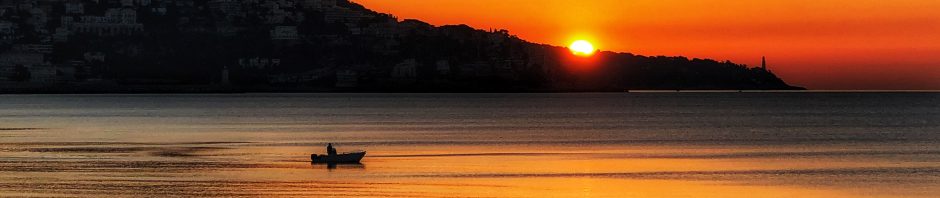
We’re planning a trip to France. It’s been ages for me. And, pity him, my husband has never been to Paris.

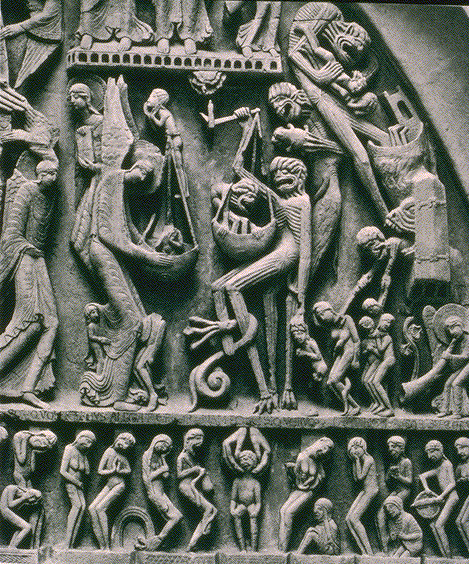
In my college days studying art history, I was a cathedral maven. Certain towns would end up on my itinerary just because of a famous cathedral. (A friend told me I reminded her of the main character in Mary McCarthy’s “Birds of America”, which I later read. He was indeed fascinated by cathedrals.) But I never made it to Autun or Vezelay in Burgundy, so now we’re going. Last night I was riffling through my medieval art books to review what I recalled of the Romanesque and Gothic. And I also recalled that had I done things differently, I might have gotten a post-graduate degree in medieval studies.
Maybe I presciently knew that at some point in my life a Dark Ages analogy would be appropriate, I don’t know. But looking at the photos of the cathedrals sparked my memory not just of sublime art but of feudal towns, religion, ignorance and barbarism. Many of these cathedral squares were also the sites of witch burnings, execution of heretics and public floggings. The feudal economy was resource based and owned by royalty and, through it, the Church. Most people were poor and barefoot and the women were usually pregnant. Being illiterate, they got virtually all their information about the world from the pulpit. Only the monks and progressive elites were literate. Through fear of Satan, the Inquisition and hell, they clung to faith and dogma. And to ensure a place in heaven, they built cathedrals as symbols of divinity.

To safeguard themselves from the single biggest threat of the times, the brutality of the era, those among the luckiest of feudal societies were held together as in a tribe by a ruler who slew anyone who got in the way of safety. Not much else mattered, and so for a thousand years or so, progress was slow and mostly did not impact the masses. Life was small — your village, family, fellow churchgoers, the chickens in your coop and your knitting circle. Venturing outside might mean falling off the edge of the world. The Cathedrals made that world bigger.

That was the mega-trend.

The counter-trend was the preservation by some elites of knowledge. Without them, the engineering of the cathedrals would not have happened. The books, otherwise known as The Word or The Light, would have been dust. The West would not have had its Renaissance. Would the West have been discovered without the navigation tools science made possible? Would there have been the 18th century Enlightenment, of which the USA founding fathers were a part? Maybe we wouldn’t have Google.

What the Dark Ages point out to me is that the history of people and of humanity are so different. I will be eternally grateful not to have been a 9th century serf. But with the legacy those serfs left in the cathedrals, I’m glad to be their descendant. And so it goes. One can only hope that beyond our Twitter streams, micro-niches and red/blue enclaves there is something greater going on.
Posted in Cathedrals, France | Tagged , , | Leave a comment

Salad Days

Oh, we are in the midst of some gorgeous late summer weather. Finally. Here in the Pacific Northwest we’ve had a dud of a season, with many unseasonably muggy, gray, rainy, cold days and not days like these, sheer perfection in their dry, sunny warmth.  At last we can comfortably eat outdoors.

I notice everything tastes better and am reminded of something M.F.K. Fisher said a long time ago. She wrote while she was in sun-drenched Provence in southern France, about how the tomatoes, vegetables and herbs bought that morning at a market were overripe by that evening from the weather. This meant they had to be eaten right away and every juicy bit dripped with flavor.

There is in fact a physiology of taste, and most of us, myself included, don’t often think about it very deeply nor do we think about what enhances it. Sometimes, it can simply be the weather.

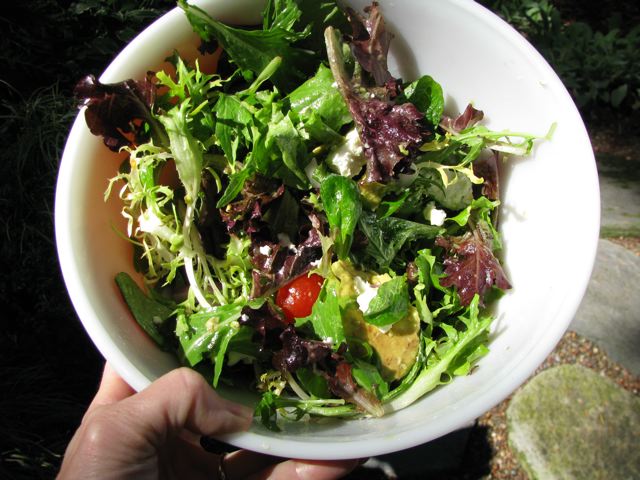
I’ve been indulging twice daily on fresh salad fixings, as I have before in other seasons. But this week, after stepping outside and being in the sun just a few seconds, I can taste a beautiful collison of mild perfume from the lettuces, punctuated with a dash of onion, sweetened with tomato and polished off by the refined tang of a vinaigrette. The salad sparkles in more ways than one.

Posted in Uncategorized | Tagged , , , , , | Leave a comment