Andrei Tarkovsky and Italy

tarkovsky0181

Years ago I saw a film by the unique, mysterious cinema artist Andrei Tarkovsky that included an early scene at an Italian hot springs town. What was immediately arresting about the scene was the film’s image of the town, which instead of a the usual piazza seemed to have a vast hot spring pool at its center. As I seem to recall, surrounding this ancient, steaming pool was an arcade through which two of the film’s characters, one native Italian and the other expatriate Russian, walked and talked as they attempted to connect emotionally. A dripping, gurgling sound followed them, the stone looked cracked and unclean, the light was dim, and instead of bringing to mind ideas of rebirth and health the pool side sequence left me with a clammy sensation of sickness, and the lingering, lush scent of mold. The film itself, like most of Tarkovsky’s works, was taxing, alternately appealingly poetic and exasperatingly incomprehensible.  But I liked it; it is a rare example of slow film, so to speak. And I find value in slow on the few occasions when I practice it.

Tarkovsky traded in themes of existential alienation (see: Solaris), and “Nostalghia” is resonant with themes of rootlessness, the incompatibility of different cultures and the quintessential Russian obsession with the inner soul. The characters attempt love, and fail; the villagers attempt health by bathing in the pool but age anyway; local women attempt fertility by praying to the Piero della Francesca “Pregnant Madonna” but the cure is not certain.  The male lead suffers from terminal doubts on the meaning of existence.

bagno-vignoni

I know Italy pretty well, and have long pursued its many hot spring sites with fervor, but I’d never known of such a weird place, and for a while imagined it didn’t even exist. The Internet was way off into the future at that time and a search for “Tarkovsky, Nostalghia, hot springs” was not an option. Then, several years afterwards, an Italian magazine featured the town and its drenched piazza, on a sunny day, on its cover. So it was real after all.

And now it looks like I’ll finally get there. It turns out the bath is named after St. Catherine, my namesake.   I’ll erase the dank image with the non-existential happiness of my daughter’s company as we let the hydromassage turn our limbs to jelly. But Tarkovsky’s unanswered questions will stay on my mind.

Posted in cinema, culture, film | Tagged , , , , , , , | Leave a comment

A citizenship for the Internet age?

social-networks1

I’ve been reading Jeff Jarvis’ “What Would Google Do?” on the open and closed opportunities offered by the Internet.  For anyone who’s been watching the spread of search, Facebook, Twitter and all these powerful kill-the-intermediary communication tools, the book won’t carry any surprises. But it is great at describing how disruptive Web 2.0 communications has been and will continue to be.

Not only has high speed Internet dis-intermediated anything and any one who stands in the way of direct communications, it has created network behavior.  This is a totally new 21st century phenomenon and it makes all kinds of things newly possible for individuals and groups. It has relegated a lot of professions to the past, but given rise to new jobs and specialties. It helped elect the last U.S. president.  It is replacing traditional newspapers and magazines.  It has created the expectation among Internet users — which is now most people in the U.S. and Western countries — that issues of big import will take citizens’ views into account. (Note to Obama: Better early in the process than after the fact, as in budget campaign.)

But what is frustrating is how even after all this disruption few industries get it.

Education.  Why do we have a 20th century system where students show up daily at a given place and time and sit in groups segmented by age and grade, following teachers who are in command mode attempting to teach in style and content from and outdated playbook? You wouldn’t even need vouchers if this system was modernized and chances are we’d have better educated kids.
Government. Why wasn’t the Obama budget online before the vote took place? And why can’t we have members of Congress who really know what Twitter is for?
Entertainment. Why can’t I customize my TV content? Until I can it’s not Comcastic at all.
Law enforcement: A Canadian student alerted a rural UK police station of an impending school massacre, which was then averted. Why didn’t Scotland Yard catch this? Why don’t police bureaus connect better with communities?
News media: Stop the presses already.

One could go on.  There is no sector spared in the disruptions going on and to come.  So shouldn’t that include not only how we consume data, services and products, but also how we behave as citizens?

Observing my daughter’s elementary through high school curriculum I could not help but wonder what happened to civics instruction.  Ok, it was boring back when I was in school, but necessary. And today the subject is fraught with dynamism.  Hey, I’d enjoy taking a class made relevant by incorporating current events.

Because since election 2008 we’re mobilized, we’re organized by interest groups and we’re experienced in the power of taking action through the Internet.  I’d love for us to keep it up.

Posted in Uncategorized | Tagged , , , | Leave a comment

Family

mathieu-almaric-in-a-christmas-tale

Often it is only shared blood that constitutes the basis for a group of people to be called “family.” Sometimes a family is emotionally stronger for lack of blood ties. Which ever it is, family is such a fundamental concept to humankind, that we all want one.

If you were to provide an oral history of your family, what would be the story? Would it be the same as your siblings’ and parents’? One of the many reasons Arnaud Desplechins’ movies resonate with audiences is for the skill with which he conveys the intermingling of memory, myth and reality in exploring the theme of family disunity. He seems to be saying that every member of a family has his or her own personal myth, and the fact that they rarely map to the others’ is the source of the family conflicts with which most of us are familiar.

A person’s mythic role within a family — whether to one’s own mind that of hero, survivor, savior, prodigal, favorite, rock, martyr, victim or leader to name a view options — becomes an obstacle against proper empathy with each other. I wonder if it all comes down to love, and how it is apportioned and expressed. Not all mothers and fathers love their children, and children have been known to hate their parents.  Or maybe it comes down to genes, an undetectable brain chemistry.   Regardless, as the Salon.com critic said in reviewing Desplechins, some people are most lost within the context of their families.  It can be sad to see, but the goal should not be unity necessarily but a less idealized accommodation than we are normally offered by culture.

In the past, before powerful courts of law, family feuds took care of personal gripes and griefs. People didn’t always try to get along, and weren’t always expected to. Self-banishment would put geography between incompatible people.  Violence settled matters. Now that we are more civilized and globally connected there is no escape….we talk it out, thinking we can understand each other, even if the misunderstandings are embedded so deeply that for most a lifetime of meditation or mediation might not help.

I’m always struck by how specific incidents are recalled differently by the individuals involved. Who is correct? Within families, these memories often begin early and cluster around old power struggles, hurts, slights or resentments and become part of the fabric of one’s psyche and personal narrative. They almost never go away, and the feelings almost never stop stinging. So everyone is correct. And therein lies the source of dysfunction.

American films tend to deal with family dysfunction with tired old tropes: parental affairs, siblings as mental cases, substance abuse, physical violence. A some point someone opens up a metaphoral vein and releases of flood of emotion that the family coalesces around. The family is healed. Desplechins doesn’t console us with any of that. Dysfunction is alive and well in families with none of those pat excuses. In Desplechins’ films, there are reconciliations but they are not resolutions. He refers to the psychological baggage we carry around, that prevent us from fully functioning, as “impedi menta.” It’s nice to have a label for it. The point is we live with our experience of family forever. It is what it is. Our memories and myths are us.

Posted in cinema, culture, film, Uncategorized | Tagged , , | 1 Comment

Contemplating race

beige_travertine_5001

Interesting article in The Atlantic Monthly.

It creates a picture of some of the ways the U.S. racial divide has manifested itself culturally in recent times, for example with hip hop on one side, and white trash studies on the other. I always wondered what the latter was about, and according to some professional students of American life, it has to do with the fear of losing whiteness that has been there since slavery.

If the rise of Obama points to changes in race relations, the article posits, it could be that Generation Y has crossed all kinds of divides, including racial ones, in the socially networked lives.

“Perhaps this is where the future of identity after whiteness lies–in a dramatic departure from the racial logic that has defined American culture from the very beginning. What [cultural historians] are describing isn’t merely the displacement of whiteness from our cultural center; they’re describing a social structure that treats race as just one of a seemingly infinite number of possible self-indentications.”

And perhaps Obama can embody and inspire a lasting set of  values that express what it is to be American for everyone regardless of racial origin.

Let’s hope.

Posted in Uncategorized | Tagged , , | Leave a comment

2009

threepenny1976ny

From time to time in the period just before the latest U.S. presidential election, one heard comparisons between the George W. Bush regime and Germany’s Wiemar Republic of 1919-1933.  The gist was that W’s attempts to wield absolute power, fight hubristic wars and bankrupt a once prosperous country were reminiscent of the period in German history that set the stage for the rise of Nazism.

A brief study of Germany during Weimar and one can easily arrive at the conclusion that there is no serious comparison.  Yes, W’s regime was monarchical and absolutist.  But we were lucky enough not to suffer through everything Germany did in the pre- WWII days.  Their reality was:

  • war debt and onerous war reparations to foreign enemies
  • Large trade deficits
  • Growing household debt
  • loss of resources (due to blockades)
  • political agitation by Communists, Anarchists, National Socialists
  • French and Belgian occupations of border areas
  • national humiliation at the hands of enemies
  • currency devaluation
  • hyperinflation when the government started printing money with no assets to back it up
  • labor unrest and strikes
  • starvation
  • loss of faith in capitalism
  • loss of faith in government

Okay, a lot of these look familiar but what is different is degree and context: Weimar Germany was still making a transition from monarchical rule to democracy, in itself a phenomenon fraught with risk and instability.  Institutions were weak and few legitimate channels for public expression of discontent — as in true Parliamentary representation — existed.   Germany was going through a geopolitical and socio-economic re-ordering on a massive scale. And it was doing it with the added pressure of economic collapse.

Oops. So that sounds eerily familiar too. 

In fact, what concerns me is that we are still heading towards the shocks that will bring us close to Wiemar conditions. According to some points of view, as in Weimar Germany the U.S. is exhausting its economic defenses. Barack Obama has stated more than once that we are running out of traditional mechanisms for dealing with the economic collapse crisis. The number of people on food stamps is rising; home foreclosures may double in 2009; unemployment is ratcheting up.

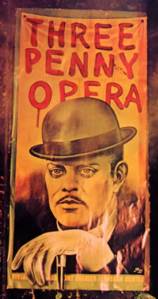
At what point in the downturn will social peace be threatened? As a director of a recent production of the Weimar-era “Threepenny Opera” written by the “hip hop artist of his age” composer Kurt Weill, and playwright Bertold Brecht, morality goes out the window when people have no choices on how to survive. And in France, recent reports indicate official concern over anarchist-type activity.

And then there’s that sense that we are not just dealing with a worse recession than normally seen, but with the need for a massive re-ordering of literally our way of living. Our current context is uncertainty — we have to grope our way in the dark and hope we are going towards the light — against a global backdrop of increased geopolitical tensions. Let’s see, will Iran take any action now that the Israeli Army is on the ground in Gaza, complicating our withdrawal from Iraq? Will India and Pakistan forge a peace or nuke each other? Will Barack Obama normalize relations with a post-Fidel Cuba or relive a missile crisis, this time with Putin’s Russia involved? How will global warming be a factor in how well we succeed in coming out of this?

So here’s another difference between then and now: technology.  The Internet is still empowering groups and individuals and creating opportunity for political, entrepreneurial and creative expression.  It is also a source of information.  Lastly, it offers an infrastructure for forming community, which will be important in the age of austerity. This is why Net Neutrality must be preserved and why the Internet must stay free.

It will take more than technology to save us, but it could be one factor among a few that make a huge difference on how things turn out.

Posted in Uncategorized | Tagged , | Leave a comment